
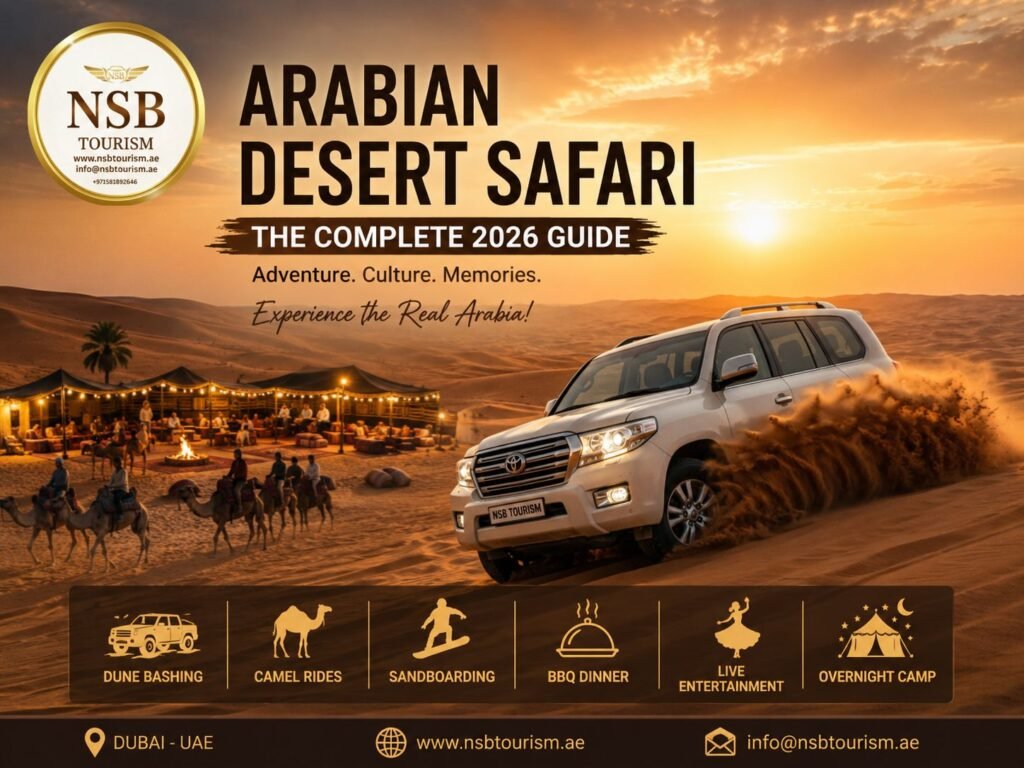
An Arabian desert safari is a guided excursion into the UAE’s desert that typically combines 4×4 dune driving, cultural camp activities, and optional add-ons like camel rides, sandboarding, and dinner shows, and it is one of the most popular bookable experiences for visitors to Dubai and Abu Dhabi. If you’re trying to choose between a shared evening trip, a private vehicle, or a gentler family-friendly option, the right answer depends on who’s travelling, how much motion you can handle, and whether you want adrenaline or atmosphere.
The desert behind this experience is not small or symbolic. The Arabian Desert spans about 2.3 million km² (900,000 sq mi) across the Arabian Peninsula, and the UAE itself is roughly 84% desert, with Abu Dhabi Emirate about 97% desert according to a regional source cited in Britannica’s Arabian Desert overview. That geography is why desert safari products sit at the centre of tourism planning in Dubai and Abu Dhabi, not on the fringe of it.
For travellers, that matters in practical terms. The safari you book is usually a half-day or full-day block that starts with hotel pickup, moves into dune country, and finishes with either a camp evening or a straight return. The smart way to book is to match the format to the traveller, not the brochure copy.
Book Your Arabian Desert Safari Adventure
Experience an unforgettable Arabian desert safari with dune bashing, camel rides, sandboarding, sunset photography, BBQ dinner, live entertainment, and traditional desert hospitality. NSB Tourism can help you choose the right morning, evening, private, family, or overnight safari package.
Table of Contents
- What an Arabian Desert Safari Is
- The Main Types of Arabian Desert Safaris
- A Typical Evening Safari Itinerary Hour by Hour
- How Much an Arabian Desert Safari Costs
- Best Time to Go on an Arabian Desert Safari
- Packing and Safety Essentials for the Desert
- How to Book an Arabian Desert Safari Without Regret
- Arabian Desert Safari FAQs
What an Arabian Desert Safari Is
An Arabian desert safari is a guided trip out of Dubai or Abu Dhabi into open dune country, usually with a mix of adventure driving, camp-based activities, and optional extras such as camel rides, sandboarding, and dinner entertainment. For a quick visual of how the day is usually structured, this infographic of the four main stages of the experience shows the flow from pickup to camp. It is a structured desert outing built around the UAE’s real terrain, and that is why it feels different from a city attraction.
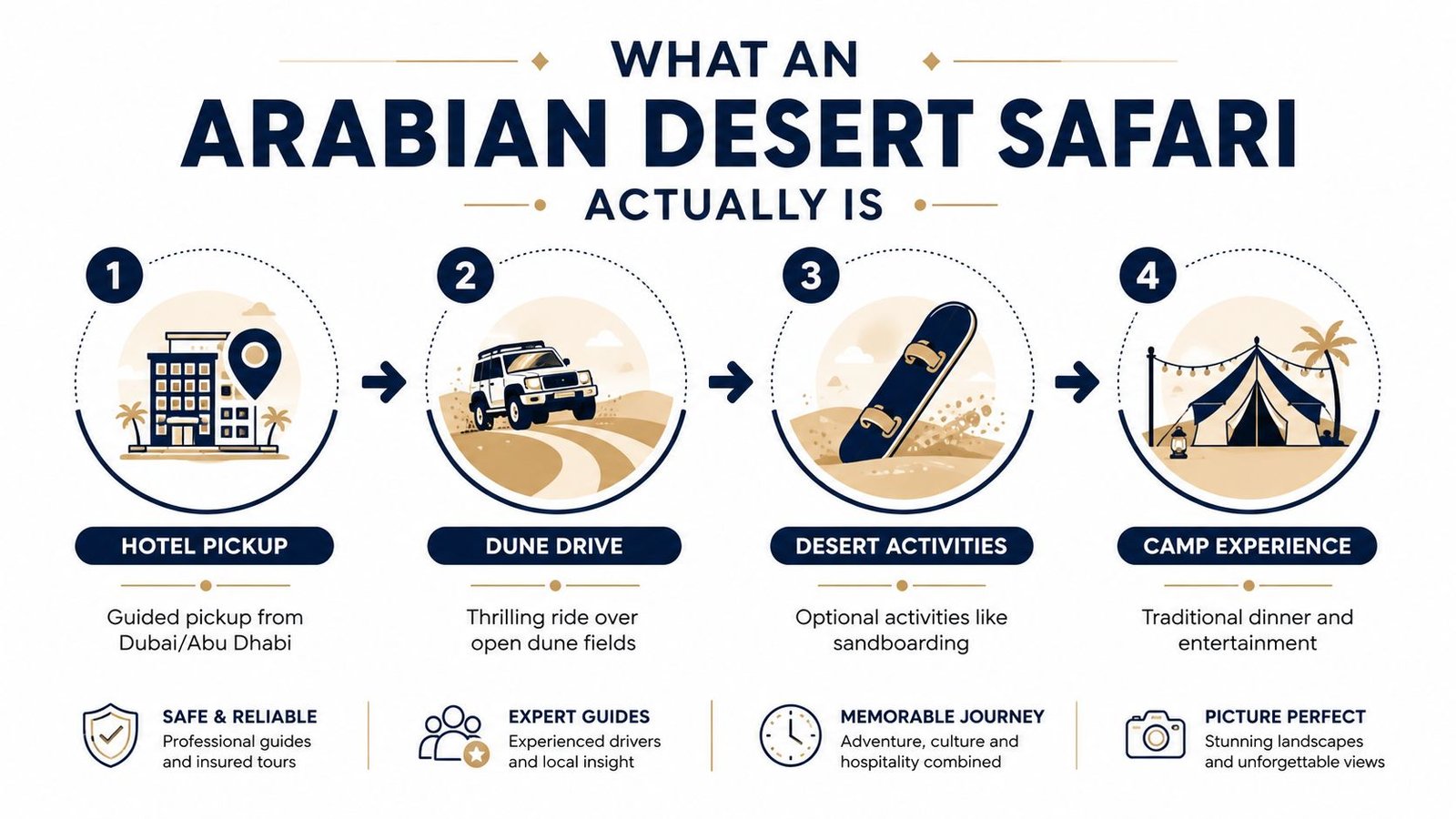
The setting shapes everything. The Arabian Desert stretches across a vast part of the region, and in the UAE the land is overwhelmingly desert terrain, which is why safari operations cluster around accessible dune corridors instead of deep wilderness. A practical safari day usually starts with hotel pickup, then a transfer to a meeting point near the dunes, then a safety briefing before the 4x4s head out. If you want to compare formats before booking, NSB Tourism’s desert safari experience options are a useful reference point for the different styles travellers choose.
Practical rule: if a safari listing does not clearly separate dune bashing, camp time, and add-ons, it is usually hiding how the day really works.

Hotel pickup is the first checkpoint, and the transfer is where travellers realise this is not a quick city outing. Once the vehicles reach the dune area, the driver checks conditions, lowers tyre pressure for sand, and the group gets ready for the drive. If the safari includes dune bashing, that section usually comes before sunset, because the lighting is better and the temperatures are more comfortable.
Some safaris skip dune bashing entirely. Those suit travellers who want scenery, wildlife, or cultural atmosphere without the bumps. I would point families with very young children, older adults, and anyone with motion sensitivity toward that calmer format.
The Main Types of Arabian Desert Safaris
The biggest mistake travellers make is treating every safari as the same product. It isn’t. Morning, evening, overnight, private, and VIP formats all solve different problems, and the wrong one can leave you bored, exhausted, or stuck paying for features you didn’t want.
| Safari Type | Typical Duration | Key Inclusions | Best For |
|---|---|---|---|
| Morning Safari | 3 to 4 hours | Short desert drive, activity-focused format, no dinner | Travellers who want a quick desert hit and still have the afternoon free |
| Evening Safari | 6 to 7 hours | Dune driving, sunset stop, camp visit, dinner, entertainment | First-time visitors, couples, and most families |
| Overnight Safari | Extended into the night | Evening safari elements plus sleeping and breakfast | Travellers who want a longer desert experience |
| Private Safari | Flexible | Chauffeur-driven 4×4, custom timing, more control over pace | Families, small groups, and privacy-first travellers |
| Luxury or VIP Safari | Flexible | Premium seating, plated or upgraded service, shorter transfer feel | Guests who care more about comfort than cost |
A morning safari is the cleanest option for travellers who dislike long evenings or just want a desert activity block. It usually skips dinner and camp entertainment, which makes it the most efficient format. An evening safari is the standard choice because it gives you the full arc of the desert, from drive to sunset to dinner.
An overnight safari adds sleeping and breakfast, so it's for people who want the desert after the day-trippers leave. A private safari is not about luxury by default. It's about control, which is useful if you're travelling with children, older parents, or anyone with a slower pace.
A luxury or VIP safari is worth it if you care about comfort more than adrenaline. If you just want the ride and the photos, don't overpay for it. If you want smoother logistics and a calmer camp setting, it can be the right call.
For travellers considering a more specialised option, dune-buggy safaris and conservation-reserve safaris also exist. NSB Tourism's overnight desert safari page is a useful reference point for anyone who wants to compare a longer stay against the standard evening format.
Arabian Safari Royal's Abu Dhabi statistics and facts notes that one operator reports 12M+ annual visitors to Abu Dhabi, 53% of them for leisure, with average visitor spend of US$149 per day and an average stay of 2.6 days. That matters because safari products are usually sold as short, high-value add-ons rather than standalone holidays. The choice is simple, do you want adrenaline, atmosphere, or both?
A Typical Evening Safari Itinerary Hour by Hour
Book an evening safari if you want the full desert cycle in one outing. It gives you pickup, dune driving, sunset, camp time, dinner, and the return ride without forcing you to piece the day together yourself. The standard timing is predictable, and that helps. Most operators collect guests around 3:00 to 3:30 PM, then drive 45 to 75 minutes out towards the dune meeting point.
The pre-drive briefing is where a good operator earns its money. The vehicle should be an air-conditioned 4×4 with seatbelts in every row, because that is the baseline for a proper desert run. Tyres are then deflated for sand flotation, and that change is what keeps the vehicle stable on the dunes instead of fighting them, according to Arabian Safari Royal's vehicle guide. If a company skips that explanation, I would question the rest of the operation.
The dune-bashing block usually lasts 30 to 45 minutes, then the convoy stops on a high ridge for sunset photos. After that, the group heads into the desert camp. Expect welcome refreshments first, then optional camel rides, henna, falcon photo opportunities, and shisha if the camp offers it.
The desert cools quickly once the sun drops. Evening temperatures can fall sharply after sunset, and guests feel the change as soon as the light disappears, which is why camps bring out blankets and move people toward covered seating. The seasonal range and strong day-to-night cooling pattern are covered in Britannica's Arabian Desert reference, and the same effect shows up clearly in the UAE's National Center of Meteorology climate information.
Dinner usually comes after the camp activities, followed by stage entertainment such as tanura and belly dance. The whole evening typically lands in the 6 to 7 hour window. If your operator sells a “short evening safari” and still includes dune driving, camp dining, and live entertainment, treat that as a sales label, not a meaningfully shorter experience.
Book an evening desert safari in Dubai

How Much an Arabian Desert Safari Costs
I won't pretend there's one fixed 2026 price for every safari, because operators revise rates seasonally and by camp quality. What matters is the band, not the exact figure. If a quote looks wildly cheap, it's usually missing pickup, food, or the activity you wanted.
| Tier | Usual Cost Band | What's Usually Included | What Often Costs Extra |
|---|---|---|---|
| Shared Evening Safari | Lower budget band | Shared 4×4, camp access, dinner, basic entertainment | Quad biking, premium seating, photos, private transfers |
| Private Safari | Mid to higher band | Private vehicle, custom timing, more flexible pace | Add-ons, premium camp upgrades, special photography |
| Premium or VIP Safari | Higher band | Better seating, upgraded service, smoother camp experience | Alcohol where available, upgraded activities, specialist requests |
| Overnight Safari | Highest common band | Evening safari plus sleeping setup and breakfast | Private tenting, premium bedding, exclusive add-ons |
| Dune-Buggy Experience | Separate activity band | Buggy use and terrain driving | Guide add-ons, extra time, transfers, safety extras |
Dubai and Abu Dhabi both have shared and premium safari products, but the final quote changes with pickup zone, vehicle type, group size, and camp standard. Extra charges often appear when pickup is outside the main city area or when a camp adds premium seating, photography packages, or optional ride time. The cheapest shared safari is usually a fair product if it comes from a licensed agency and the inclusions are written down clearly.
Dune-buggy pricing deserves its own mental bucket. On Al Badayer dune-buggy experiences, Polaris RZR units are described with 1,000cc engines for moderate dunes and mixed terrain, while Can-Am Maverick X3 buggies are listed with 200+ HP turbo engines and race-ready suspension for deeper ridges and longer slopes. That means the vehicle choice changes the experience materially. Beginners do better in the controllable platform, while confident drivers will feel the stronger machine immediately.
Check Abu Dhabi desert safari cost options
If you're budgeting, think in three buckets. Budget travellers should expect a basic shared product. Mid-range travellers should look at private or better-run evening safaris. Premium travellers should pay for comfort, not for vague “VIP” labels that don't describe the actual service.

Best Time to Go on an Arabian Desert Safari
Book your Arabian desert safari between October and April if you want the trip to feel worth the money. That is the stretch when the desert is comfortable enough for dune driving, camp dinners, and sunset photos without the heat running the whole experience. Peak demand also sits here, and for good reason, the product works better.
Summer in the UAE is a different story. The UAE climate and desert conditions make daytime heat a real factor in the open desert, while winter evenings can turn cool enough that you will want a light layer once the sun drops. That is why evening safaris are strongest in the cooler months. The full format, from dune bashing to dinner, feels far more relaxed when the weather is on your side.

Which months suit which traveller
- Photography travellers: November to February gives cleaner light and less discomfort while you wait for the right dune angle or sunset frame.
- Families with children: December to February is the easiest window for young children and older relatives who do not want to sit through heat.
- Budget travellers: September can work as a shoulder month if you can handle warmer conditions and want more room on availability.
Summer safaris still operate. Operators adjust the format. Pickups move earlier, air-conditioned stops matter more, and comfort management becomes the priority. If you do not like heat, do not book a desert dinner in the middle of summer and then expect a cool evening.
Ramadan changes the pace too. Pickup times often shift later, and entertainment is usually toned down, so the evening feels quieter than a normal safari. That works well if you want a calmer atmosphere and less noise. It is a different product, not a worse one.
The practical rule is simple. Choose October to April if you want the full social camp experience and the easiest conditions for most travellers. Choose summer only if you are comfortable with heat and want a less crowded feel. Evening safaris are still the most flexible option year-round, but the cooler season gives you the version people remember fondly.
Packing and Safety Essentials for the Desert
Pack for dust, temperature change, and sand, not for a city walk. The wrong shoes or the wrong bag can make a short safari annoying in a way no brochure warns you about. Keep it simple and practical.
NSB Tourism's desert safari outfit guide is a useful starting point, but the essentials are straightforward.
- Closed-toe shoes: Sand gets everywhere, and open shoes are a bad idea once you leave the vehicle.
- Light long sleeves: They help in the evening when the air cools and also give you some protection from the sun.
- Light jacket: Camps can feel noticeably cooler after sunset.
- Sunglasses and headscarf or buff: Both make dune wind and sand much easier to handle.
- Small backpack, sunscreen, charger, dry bag: Keep valuables organised and cameras protected.
Practical rule: don't carry heavy jewellery or anything delicate. Fine dust finds its way into zips, straps, and corners fast.
Safety matters just as much as packing. Confirm that every seat in the 4×4 has a seatbelt. Tell the operator upfront if you get motion sickness, because a good driver can keep the ride calmer. Pregnant travellers, and anyone with serious back or neck conditions, should skip dune bashing and book a gentler format instead.
Children's age policies vary, but many operators set a minimum of 3 to 5 years for dune bashing while allowing younger children in camp-only formats, according to the operational guidance in the brief. If you're travelling with seniors or anyone who doesn't want bumps, choose a sunset drive, a camp-only evening, or a nature-reserve safari through the Dubai Desert Conservation Reserve, which covers 225 square kilometres and protects Arabian oryx, gazelles, and desert foxes according to desert-safari-dubai-facts.
How to Book an Arabian Desert Safari Without Regret
Start with proof, not promises. A legitimate safari company should show a Dubai tourism licence, name the driver-guides, list inclusions in writing, explain cancellation terms clearly, and provide a real customer support channel rather than only a WhatsApp number. If any of that is missing, keep looking.
The common traps are easy to spot once you know them. A bait price that excludes pickup is not a good deal. A camp that suddenly sells compulsory quad biking is not being transparent. A vehicle downgrade after payment is a bad sign, not an accident.
Booking through a Dubai-based travel agency can solve a lot of those problems because the transport, timings, and handoff points are managed in one place. NSB Tourism is one option in that space, and it offers desert safari packages alongside Dubai tours, attraction tickets, airport transfers, and visa support. That kind of bundling helps when you're pairing a safari with a Burj Khalifa ticket, a Dubai city tour, or an Abu Dhabi city tour in the same week.
If you want a simple checklist before paying a deposit, use this:
- Licence and identity: Confirm the company is operating legally and tells you who is picking you up.
- Written inclusions: Make sure dinner, transfers, and camp access are spelled out.
- Add-on discipline: Check whether photos, rides, or premium seating are optional or required.
- Transport honesty: Ask what vehicle you're getting, not what the ad photo shows.
The cheapest quote is rarely the best deal once transport, transfers, and extras are counted. Pay for clarity. That saves more money than chasing the lowest headline number.
Arabian Desert Safari FAQs
How early should I book during peak season?
Book as early as you can if you want a cooler month and a specific format, especially for private or premium safaris. Shared products are easier to find, but the best camp slots and pickup times still go first.
What does a private safari change compared with a shared one?
A private safari gives you control over timing, pace, and vehicle use. It doesn't automatically mean a fancier camp. It removes the shared schedule and gives your group more flexibility.
Can I skip dune bashing for medical reasons?
Yes, and you should. Tell the operator before you book. Camp-only evenings, sunset drives, and reserve-style desert experiences are the better choice if motion is a problem.
What is the overnight safari sleep setup really like?
It's usually a camp stay after the evening activities, not a hotel room in the dunes. Expect a simpler, outdoor-style night with breakfast the next morning.
Should I tip the driver or guide?
A tip is optional, but it's appreciated when the driver is careful and the service is organised well. Keep it modest and based on the experience you received.
Which safari suits families best?
A private evening safari or a camp-focused format is usually the safest bet for families. If your children are very young, avoid heavy dune bashing and ask for a gentler schedule.
Plan your desert day around the traveller, not the sales pitch. Arabian desert safari bookings get a lot easier once you know whether you want a shared evening, a private vehicle, or a softer desert experience with less bumping around. If you want one place to sort tours, tickets, transfers, and safari timing together, NSB Tourism can help you line up the right Dubai or Abu Dhabi option without guesswork.
Book Your Arabian Desert Safari Adventure
Experience an unforgettable Arabian desert safari with dune bashing, camel rides, sandboarding, sunset photography, BBQ dinner, live entertainment, and traditional desert hospitality. NSB Tourism can help you choose the right morning, evening, private, family, or overnight safari package.