
US tourist visa interview preparation UAE residents complete before attending their B1/B2 appointment can help them explain their travel plans clearly and accurately. Whether you are applying from Dubai or Abu Dhabi, the interview gives a U.S. consular officer an opportunity to understand the purpose of your visit, your personal circumstances, your financial arrangements and your intentions after the trip.
However, preparing for an interview does not mean memorising answers or rehearsing a story designed to secure approval. Instead, applicants should understand their genuine travel plans and be ready to explain them honestly. Additionally, the information they provide should remain consistent with their DS-160 application. For professional application preparation support, explore NSB Tourism’s visa services in the UAE.
This guide explains how to discuss your intended U.S. visit, trip duration, accommodation, travel funding, employment in the UAE and return plans. Furthermore, it covers common B1/B2 interview questions, previous travel and visa refusals, interview preparation mistakes and important official U.S. government guidance.
Preparing for your U.S. visa interview?
NSB Tourism LLC helps UAE residents organise B1/B2 application information, review supporting documents and understand interview preparation steps.
What Does a U.S. Tourist Visa Interview Assess?
A U.S. visitor visa interview helps the consular officer assess whether the applicant qualifies for the relevant temporary visa classification.
For example, the officer may consider the applicant’s travel purpose, intended activities, personal circumstances, ability to fund the visit and intention to depart the United States.
Additionally, the officer may review information previously provided in the DS-160 application.
However, a visa interview is not an examination with one correct set of prepared answers. Every application is assessed according to its own facts.
Does the Consular Officer Only Check Your Documents?
No. The officer may consider both the application information and the applicant’s responses during the interview.
Although supporting documents can be relevant, they do not automatically establish eligibility.
Therefore, applicants should understand their circumstances rather than relying entirely on a folder of paperwork.
Why Is the Temporary Nature of the Visit Important?
B1/B2 visas are intended for permitted temporary visits.
Consequently, applicants generally need to establish that their intended activities fit the visitor category and that they plan to depart after their temporary stay.
For current requirements, see the official U.S. Department of State visitor visa guidance.
How to Explain Your Travel Purpose During a U.S. Tourist Visa Interview
Explaining why you want to visit the United States is one of the most important areas of interview preparation.
Therefore, be ready to describe your genuine reason for travelling in straightforward language.
Travelling for Tourism or a Holiday
If your trip is for tourism, you may explain the destinations you intend to visit and the general activities you have planned.
For example, a traveller planning to visit New York may wish to see major landmarks, museums and other tourist attractions.
However, you should only describe activities that genuinely reflect your plans.
Illustrative example: “I’m planning a ten-day holiday in New York to visit tourist attractions and explore the city.”
This example is not a recommended script. Instead, applicants should explain their own destinations and plans honestly.
Visiting Family or Friends
If you intend to visit a relative or friend, you should be ready to explain the relationship and purpose of the visit.
For instance, an applicant may plan to spend part of their holiday with a family member living in the United States.
However, applicants should not conceal genuine relationships or falsely describe the trip as tourism only.
Attending Business Meetings
Some B1/B2 applicants travel for permitted temporary business purposes, such as meetings or conferences.
Therefore, clarify the nature of the business activity and why the visit is temporary.
However, ordinary employment in the United States is generally not permitted under the visitor classification.
Combining Tourism and Business Activities
Some travellers plan a combination of permitted business activities and tourism.
Consequently, their explanation should accurately describe both purposes when relevant.
Nevertheless, the intended activities must remain consistent with the applicable visitor visa rules.

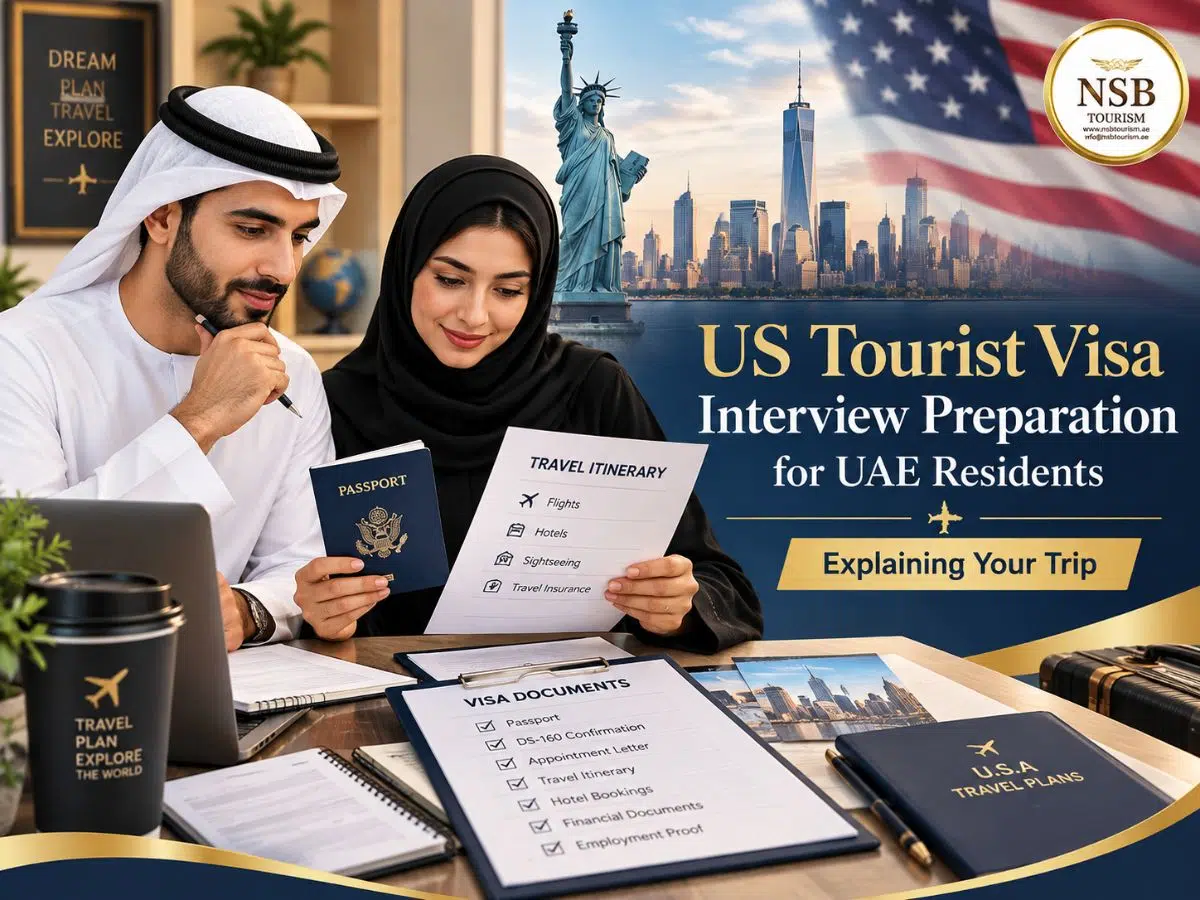
Image note: This is an illustrative interview preparation scene, not a photograph of an actual U.S. Embassy interview or an official consular document.
How to Explain Your Intended Stay in the United States
Applicants should be ready to explain how long they intend to stay and why that duration is appropriate for their trip.
For example, a short sightseeing holiday may involve several days, while a family visit may involve a longer stay.
However, there is no single ideal number of travel days that guarantees visa approval.
What Travel Dates Should You Mention?
Explain your actual intended travel dates or estimated period of travel.
Additionally, distinguish between confirmed arrangements and tentative plans.
For example, an applicant who has not purchased flight tickets should not falsely claim that the flights are already booked.
What If Your Travel Dates Change?
Plans can change between the DS-160 submission and the interview.
Therefore, if a relevant detail has genuinely changed, explain the situation truthfully.
However, material application errors may require separate action under the applicable consular instructions.
Do You Need a Confirmed Flight Ticket?
The U.S. Department of State advises applicants not to make final travel plans or purchase tickets until a visa has been issued.
Consequently, applicants should not assume that purchasing a non-refundable flight improves their approval chances.
How to Explain Who Will Pay for Your U.S. Trip
Consular officers may consider whether an applicant can cover the costs of their intended visit.
Therefore, be ready to explain the genuine source of travel funding.
Paying with Personal Savings
Applicants funding their own trip may discuss their actual income and available financial resources.
For example, a salaried employee living in Dubai may plan to pay for the visit using personal savings.
However, applicants should avoid exaggerating their income or bank balance.
Employer-Funded Business Travel
If an employer is paying for permitted temporary business travel, explain that arrangement accurately.
Additionally, be ready to clarify the connection between the planned activity and your employment when asked.
Financial Support from Family or Another Person
Another person may help pay some or all of the trip expenses.
However, third-party financial support does not automatically establish that an applicant qualifies for a B1/B2 visa.
The Department of State also explains that a letter of invitation or Affidavit of Support is not required for a routine visitor visa application.
Is There a Minimum Bank Balance for Interview Approval?
The Department of State does not publish one universal minimum bank balance that guarantees approval for all B1/B2 applicants.
Therefore, travellers should avoid following unverified advice that requires placing a specific artificial amount in their account.
Instead, they should explain their genuine financial circumstances and planned expenses.
Explaining Your UAE Employment and Professional Responsibilities
Employment and business circumstances may help the officer understand an applicant’s life outside the United States.
However, there is no single employment profile that automatically qualifies someone for a tourist visa.
Employed Applicants
Employees should understand their own job title, employer, general responsibilities and any relevant leave arrangements.
For example, an applicant may have authorised annual leave and intend to resume work after returning to the UAE.
However, these circumstances should only be mentioned if they are true.
Business Owners and Self-Employed Applicants
Business owners should be ready to explain the nature of their business and current professional responsibilities.
Additionally, they should distinguish personal earnings from total company revenue when the officer asks about income.
For instance, an applicant may own a company in Dubai and manage its day-to-day operations.
However, owning a trade licence does not automatically guarantee visa eligibility.
Applicants Between Jobs
Some applicants may be unemployed or changing jobs at the time of the interview.
Therefore, they should describe their circumstances truthfully rather than inventing an employer or employment letter.
Nevertheless, the officer may consider how the applicant intends to fund the trip and what circumstances support their temporary travel plans.
How to Explain Your Plans to Return to the UAE
For a temporary visitor visa, applicants generally need to establish their intention to depart the United States after the visit.
Therefore, officers may consider genuine connections outside the United States.
Employment and Business Commitments
Ongoing professional responsibilities can form part of an applicant’s circumstances.
For example, a UAE resident may have continuing employment or an operating business that requires their return.
However, applicants should not fabricate commitments simply to appear more established.
Family and Household Responsibilities
Family circumstances may also be relevant.
For example, some applicants have family members who live with them in the UAE.
Nevertheless, family situations differ, and the officer assesses the complete application individually.
Residence and Property
Genuine residence arrangements and property commitments may also provide context.
However, owning property is not a universal requirement for B1/B2 visa applicants.
What If Your Strongest Ties Are Outside the UAE?
Some UAE residents have family, property or other significant commitments in their country of citizenship.
Therefore, they may need to explain their ties both to the UAE and to their home country, depending on the circumstances.
Furthermore, applicants applying in the UAE based on residence should be able to demonstrate that residence under the applicable U.S. consular instructions.
What If You Are Visiting a Relative in the United States?
Applicants sometimes worry that having family in the United States automatically harms their application.
However, the relevant issue is whether the applicant qualifies for the requested visitor classification based on their overall circumstances.
Therefore, a genuine family visit should be explained honestly.
For example, an applicant may intend to visit a sibling for two weeks before returning to work in Dubai.
Nevertheless, the applicant must still meet the applicable visa requirements.
Do You Need a U.S. Invitation Letter?
A letter of invitation is not a universal requirement for a B1/B2 visitor visa.
According to the Department of State, applicants must qualify based on their own circumstances and ties abroad rather than assurances from family or friends in the United States.
Therefore, an invitation letter should not be viewed as proof that a visa will be approved.
Answering Questions About Previous Travel and Visa Refusals
Previous travel and visa history can form part of an interview.
Consequently, applicants should review the information already submitted in their DS-160.
Previous Visits to the United States
If you travelled to the United States previously, be prepared to discuss relevant visits when asked.
For example, the officer may seek clarification about an earlier trip or its duration.
However, do not invent travel dates when you cannot remember them accurately.
Previous U.S. Visa Refusals
If you have previously been refused a visa, answer related questions truthfully.
For instance, an applicant who received a refusal under section 214(b) should not conceal that refusal.
However, a prior refusal under section 214(b) applies to that particular application and is not automatically a permanent bar to reapplying.
Previous Overstays or Immigration Issues
If your travel history includes an overstay or another immigration issue, provide truthful information.
Additionally, seek advice from a suitably qualified U.S. immigration professional if the legal implications are unclear.
Keeping Interview Answers Consistent with Your DS-160
The DS-160 contains information about the applicant’s identity, background and intended visit.
Therefore, interview preparation should include reviewing those answers.
However, consistency does not mean mechanically repeating outdated information if your circumstances have genuinely changed.
Review the Important Details
For example, check your travel purpose, current employment, intended stay, family information and relevant previous travel.
Additionally, be ready to explain genuine changes that occurred after submitting your application.
What If You Notice a DS-160 Error?
Errors should be addressed according to the official application and consular procedures.
Therefore, do not assume that submitting another DS-160 automatically updates an existing interview appointment.
For detailed guidance, read our related article: US Tourist Visa DS-160: Consistency Checks Before Submitting from UAE.
U.S. Tourist Visa Interview Preparation Comparison Table
The following table shows common interview topics and practical ways to prepare.
However, these are possible discussion areas rather than a fixed list of questions asked at every interview.
| Interview Topic | What to Explain | Preparation Reference |
|---|---|---|
| Travel purpose | Why you are visiting and your intended activities | Genuine itinerary or travel plans |
| Length of stay | Intended dates and approximate duration | Available leave and travel schedule |
| Financial arrangements | Who will pay and how the trip is funded | Relevant genuine financial information |
| Employment or business | Your work and ongoing responsibilities | Accurate employment or business records |
| Return plans | Why you intend to depart after the visit | Genuine ties and commitments outside the U.S. |
| Previous travel | Relevant visits, visas and immigration history | Passport history and DS-160 answers |
Important: Supporting documents may be requested depending on the application. The comparison table does not mean every listed document is mandatory for every applicant.
Practical U.S. Tourist Visa Interview Questions and Illustrative Answers
Many UAE residents search online for typical B1/B2 visa interview questions.
However, no list can predict exactly which questions a consular officer will ask.
Therefore, the following examples are for understanding the question’s purpose, not memorising answers.
Why Do You Want to Visit the United States?
This question may help establish the intended activity.
Illustrative example: “I plan to spend a holiday in New York and visit several tourist attractions.”
However, applicants must describe their actual reason for travel.
How Long Will You Stay?
This question may clarify the intended travel duration.
Illustrative example: “I intend to stay for about ten days during my approved annual leave.”
Nevertheless, do not claim to have approved leave unless you genuinely do.
Who Will Pay for Your Trip?
This question may clarify financial arrangements.
Illustrative example: “I plan to pay for the trip using my personal savings.”
However, if an employer or family member genuinely funds the trip, explain that arrangement instead.
What Do You Do in the UAE?
This question may clarify current professional circumstances.
Illustrative example: “I work in Dubai as an operations coordinator.”
Therefore, provide your actual occupation and relevant information rather than copying the example.
Why Will You Return After Your Visit?
This question may relate to the temporary nature of the visit.
Illustrative example: “I have ongoing employment and family responsibilities in the UAE, and I intend to return after my holiday.”
However, those circumstances must genuinely apply to the applicant.
Do You Have Relatives in the United States?
Answer accurately when asked.
For example, if your sibling lives in the United States, disclose that relationship truthfully.
Consequently, never invent or conceal a family relationship because of an online interview tip.
How to Prepare for the Interview Day in Dubai or Abu Dhabi
Applicants should follow the instructions issued for their specific U.S. Embassy or Consulate appointment.
However, several practical preparations can help avoid unnecessary confusion.
Confirm the Correct Appointment Location
Review the date, time and consular post shown in your booking.
Additionally, check the current security and arrival instructions.
For example, electronic devices, bags and other items may be subject to local entry restrictions.
Prepare Your Passport and Confirmation Documents
The Department of State lists the passport, DS-160 confirmation page, any required payment receipt and an appropriate photograph when necessary among core application materials.
Furthermore, the relevant consular post may provide additional instructions.
Review Your DS-160
Before the appointment, review the submitted information so that you can answer questions accurately.
However, do not memorise false statements or conceal genuine changes.
Practise Clear Explanations
Practising how to explain genuine circumstances in simple words can be useful.
For example, try describing the main purpose, intended duration and source of travel funding without unnecessary detail.
Nevertheless, the objective should be clarity and truthfulness, not presenting a rehearsed performance.
U.S. Tourist Visa Interview Preparation Checklist for UAE Residents
Before attending your B1/B2 interview, review these six areas.
1. Travel Purpose
Understand the genuine reason for visiting the United States, whether tourism, a family visit or permitted temporary business activity.
2. Trip Duration
Know your intended travel dates, expected length of stay and general schedule.
3. Who Pays for the Trip
Be ready to explain how your travel, accommodation and other expenses will be funded.
4. UAE Employment and Other Ties
Review your genuine employment, business, family and residence circumstances, as applicable.
5. Supporting Documents
Prepare the core documents required by the relevant consular post and any additional evidence that applies to your circumstances.
6. Answer Consistently and Truthfully
Review your DS-160 information and answer questions based on your actual circumstances.
Finally, remember that preparation cannot guarantee visa approval.

Infographic note: This is an educational preparation guide, not an official U.S. government checklist. Applicants should follow their actual appointment instructions, and no interview preparation method guarantees visa approval.
Common U.S. Tourist Visa Interview Mistakes to Avoid
1. Memorising Scripted Answers
Memorised responses may not accurately represent an applicant’s circumstances.
Therefore, focus on understanding your genuine travel plans instead.
2. Giving Conflicting Travel Information
Contradictions may create confusion about the proposed visit.
Consequently, review your DS-160 details and explain genuine changes accurately.
3. Exaggerating Employment or Income
Incorrect salary, employer or business information can create serious concerns.
Therefore, only provide accurate details about your professional circumstances.
4. Assuming an Invitation Letter Guarantees Approval
An invitation letter does not replace the applicant’s need to qualify independently.
Furthermore, it is not a universal requirement for a standard visitor visa.
5. Concealing a Previous Visa Refusal
Applicants must provide truthful information about their immigration history.
Therefore, do not conceal a refusal that the application asks you to disclose.
6. Inventing Hotel or Flight Bookings
Some applicants believe they must show fully confirmed travel arrangements.
However, the Department of State advises against purchasing tickets before visa issuance.
Consequently, do not invent reservations or misrepresent tentative plans.
7. Providing Unnecessary or Unrelated Documents
Large amounts of paperwork do not automatically strengthen an application.
Instead, prepare the core documents and relevant additional evidence under the official instructions.
8. Assuming Confidence Guarantees Visa Approval
Interview confidence may help applicants communicate clearly.
However, the consular officer must determine eligibility under U.S. immigration law.
Therefore, no coaching service can guarantee a positive decision.
Example: Explaining a Genuine Holiday from Dubai to New York
Consider a fictional example involving a UAE resident employed in Dubai who plans a short holiday in New York.
The applicant intends to visit several tourist attractions, use personal savings and return to work after the trip.
Before the interview, the applicant reviews their itinerary, employment information and DS-160 answers.
Additionally, they check the approximate travel dates and expected expenses.
During the interview, the applicant explains the genuine purpose of the trip and answers relevant questions in their own words.
However, this example is not a model answer that every applicant should copy. Different applicants have different personal circumstances.
What Happens After Your U.S. Tourist Visa Interview?
Following the interview, the consular officer may approve the visa, refuse the application or determine that additional administrative processing is necessary.
However, the outcome depends on the individual case.
If Your Application Is Approved
Follow the relevant consular instructions regarding passport return, any applicable visa issuance fee and other steps.
Nevertheless, approval should not be assumed until the official process confirms the result.
If Additional Administrative Processing Is Required
Some applications require further processing.
Therefore, applicants should follow official instructions and avoid relying on a guaranteed completion date.
If Your Application Is Refused
The officer may refuse a visa under the relevant U.S. immigration law.
For example, a section 214(b) refusal may mean that an applicant did not establish eligibility for the visa category or did not overcome the applicable presumption of immigrant intent.
However, applicants should refer to the actual refusal information rather than assuming every refusal has the same reason.
For more detail, consult the official U.S. Department of State visa denials guide.
Frequently Asked Questions About U.S. Tourist Visa Interviews in the UAE
What questions are asked in a U.S. tourist visa interview?
A consular officer may ask about the purpose of your visit, intended travel period, financial arrangements, employment, family circumstances or previous travel. However, there is no fixed list of questions for every applicant.
How do I prepare for a U.S. B1/B2 visa interview in Dubai?
Review your DS-160 information, understand your genuine travel plans, confirm your appointment details and prepare the documents required by the consular post. Additionally, practise explaining your circumstances truthfully and concisely.
Is the U.S. visa interview different in Abu Dhabi?
The same underlying U.S. immigration rules apply. However, appointment arrangements, entry procedures and operational instructions may differ between consular posts. Therefore, follow the instructions for your specific appointment.
How long does a U.S. tourist visa interview take?
The interview itself may be relatively brief, but there is no universal guaranteed duration. Furthermore, the total visit can involve security checks and waiting time.
What should I say when asked why I want to visit the USA?
Explain your genuine travel purpose clearly. For example, discuss the destination and activities you actually intend to undertake. However, do not copy a fabricated answer from another applicant.
How much bank balance should I show for a U.S. tourist visa?
There is no published universal minimum balance that guarantees B1/B2 approval. Instead, applicants should be able to explain their actual financial circumstances and how the visit will be funded.
Can my relative in the United States sponsor my trip?
Another person may help cover travel costs. However, the applicant must still satisfy the visitor visa requirements. An invitation letter or Affidavit of Support is not a universal requirement for a routine B1/B2 application.
Does having a job in Dubai guarantee U.S. visa approval?
No. Genuine employment may be relevant to the assessment, but the consular officer considers the complete application and applicable legal requirements.
Do I need to own property in the UAE?
No. Property ownership is not a universal requirement for a B1/B2 visitor visa. Consular officers consider ties and individual circumstances, which vary between applicants.
What if my DS-160 travel plans change before the interview?
Explain genuine changes truthfully. However, if the DS-160 contains a material error, follow the relevant Department of State and consular instructions for addressing it.
Should I memorise sample visa interview answers?
No. Understanding possible interview topics can help, but applicants should answer according to their own actual circumstances rather than memorising scripts.
Can I bring my documents to the U.S. visa interview?
Yes, applicants should bring the core documents required under the official interview instructions and any relevant additional documents requested. However, not every supporting document is mandatory for every applicant.
Is an invitation letter required for a U.S. tourist visa?
No. The U.S. Department of State states that a letter of invitation or Affidavit of Support is not required for a routine visitor visa application.
Will a previous U.S. visa refusal affect the interview?
A previous refusal may be relevant, depending on its basis and the applicant’s current circumstances. However, applicants must disclose their immigration history accurately whenever requested.
Can I get a U.S. tourist visa without international travel history?
There is no universal rule requiring a particular number of previous international trips. The officer assesses the individual application under the applicable immigration rules.
What if I become nervous during the visa interview?
Being nervous does not automatically mean an application will be refused. Take care to listen to the question and explain your circumstances clearly and truthfully.
Does a U.S. tourist visa guarantee entry into the United States?
No. A visa generally allows the traveller to request entry at a U.S. port of entry. U.S. Customs and Border Protection makes the admission decision.
Can NSB Tourism guarantee that I will pass my interview?
No. NSB Tourism LLC can assist with organising application information and understanding interview preparation, but only authorised U.S. consular officers make visa decisions.
Related U.S. Tourist Visa Guides
For other stages of your visitor visa preparation, read these NSB Tourism articles:
- US Tourist Visa (B1/B2) Requirements for UAE Residents — understand eligibility, visa documents, fees and application steps.
- US Tourist Visa DS-160: Consistency Checks Before Submitting from UAE — learn how to check form answers before submission.
Official U.S. Government References
For current instructions and immigration rules, consult the following official U.S. government resources:
- U.S. Department of State — Visitor Visa Information
- U.S. Department of State — Visa Customer Service Statement
- U.S. Department of State — Visa Denials and Section 214(b)
- U.S. Department of State — DS-160 Application
Because visa policies and consular procedures may change, applicants should confirm current instructions before attending their interview.
Need Help Preparing for Your U.S. Tourist Visa Interview?
Planning a U.S. B1/B2 visitor visa application from Dubai, Abu Dhabi, Sharjah or another UAE emirate?
NSB Tourism LLC assists UAE residents with visitor visa application preparation, DS-160 information review, supporting-document organisation and general visa interview guidance.
Our team can help you understand the application process and organise information relating to your travel plans, employment, financial arrangements and other relevant circumstances.
Contact Our Visa Team on WhatsApp Explore U.S. Visa Assistance
Email: info@nsbtourism.ae
More services: Explore NSB Tourism Visa Services
Important: NSB Tourism LLC is an independent travel and visa-assistance company. We are not affiliated with the U.S. Embassy or Department of State, cannot issue U.S. visas and do not guarantee interview appointments or visa approval. Applicants must provide accurate and truthful information, and all decisions remain with authorised U.S. consular officers.